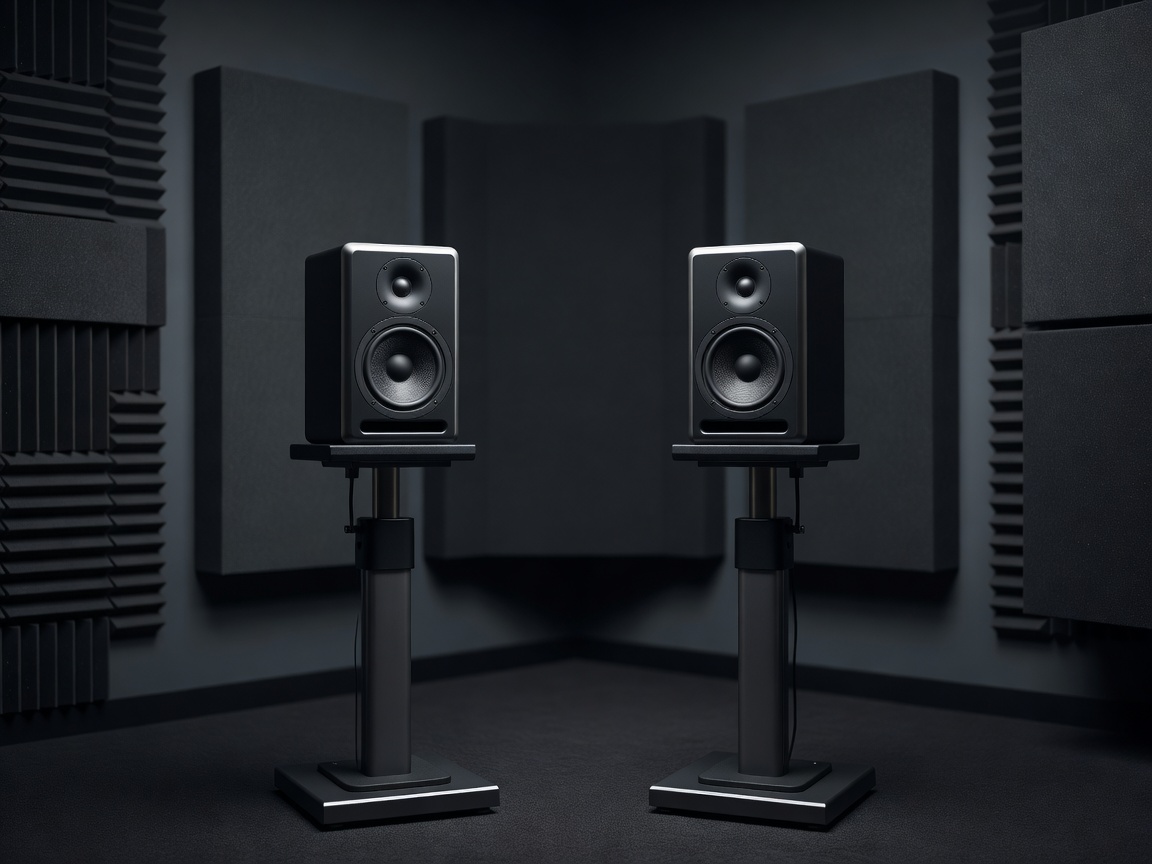
Studio Monitors
Critical Listening at Home
Consumer "hi-fi" speakers are engineered to make music sound pleasant—often boosting bass and treble to create a "smiley face" EQ curve. Professional studio monitors, conversely, are designed for brutal honesty. They aim for a flat frequency response to reveal flaws in a mix or broadcast recording.
| Specification | Consumer Hi-Fi | Active Studio Monitor |
|---|---|---|
| Amplification | Passive (External Amp) | Active (Bi-amped/Tri-amped internally) |
| Frequency Response | Colored / Sweetened | Flat / Clinical |
| Listening Position | Room-filling (Far-field) | Near-field (Equilateral triangle) |
| Inputs | RCA, Optical, Bluetooth | Balanced XLR, TRS |
The Acoustic Reality
Installing $3,000 professional monitors in an untreated drywall room is a waste of capital. The room dictates what you hear just as much as the speakers do. Commercial studios utilize tuned bass traps, broadband absorbers, and diffusers.
Proper Acoustic Treatment
- Clarity: Reduces flutter echo and reverb, dramatically improving speech intelligibility.
- Low-End Control: Thick corner traps prevent bass frequencies from building up and nullifying.
- Professionalism: Essential for clean remote broadcast or voiceover work.
The Aesthetic Compromise
- Visual Clutter: Panels consume significant wall real estate and can feel claustrophobic.
- Foam is Useless: Cheap acoustic foam only absorbs high frequencies, making the room sound "muddy" and dead. Real treatment requires dense rockwool or fiberglass.